Topic 5.3: Feedback Loops and Homeostasis
Eat a big plate of pasta and a flood of sugar enters your blood. Skip lunch and the supply runs low. Yet your blood sugar stays within a narrow range through all of it, hour after hour, year after year, without a single decision from you.
This is homeostasis: the body's way of keeping its internal conditions steady. Topic 1.6 showed it for temperature. Here you will see how hormones do the same for blood sugar and calcium.
A Quick Recall: Negative Feedback
A negative feedback loop has a set point and works to bring the body back to it. A sensor detects a change, a control center compares it with the set point, and an effector acts to reverse the change. In the endocrine system, the sensor and control center are often the gland itself, and the effector is the hormone and the cells it affects.
A positive feedback loop pushes a change further in the same direction. It is rare and usually ends in a finish line. Examples are the contractions of labor (oxytocin makes stronger contractions, which release more oxytocin) and blood clotting.
Blood Sugar: Insulin and Glucagon
Your cells run on glucose, a sugar in the blood. The pancreas contains clusters of cells called islets that act as both the sensor and the gland.
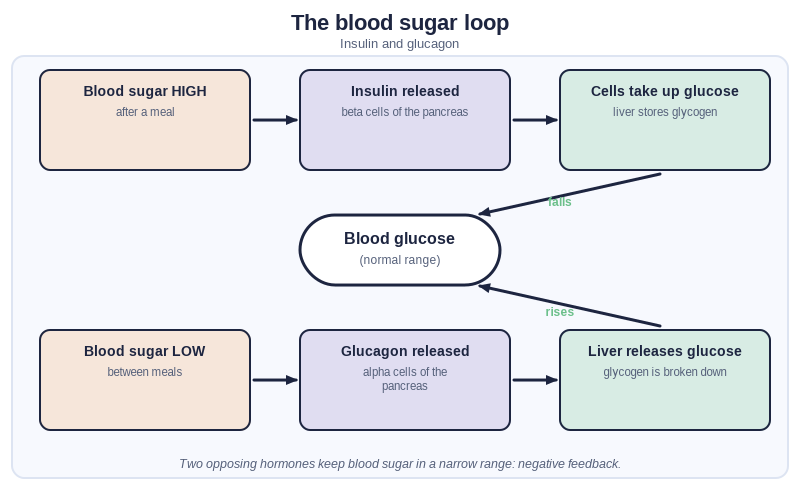
When blood sugar rises (after a meal):
- Beta cells in the pancreas release insulin.
- Insulin tells body cells to take up glucose from the blood, and tells the liver and muscles to store glucose as glycogen.
- Blood sugar falls back toward normal.
When blood sugar falls (between meals or during exercise):
- Alpha cells in the pancreas release glucagon.
- Glucagon tells the liver to break down glycogen and release glucose into the blood.
- Blood sugar rises back toward normal.
The two hormones are antagonists with opposite effects, like the biceps and triceps in Topic 3.3. Together they keep blood glucose in a narrow range.
Blood Calcium: PTH and Calcitonin
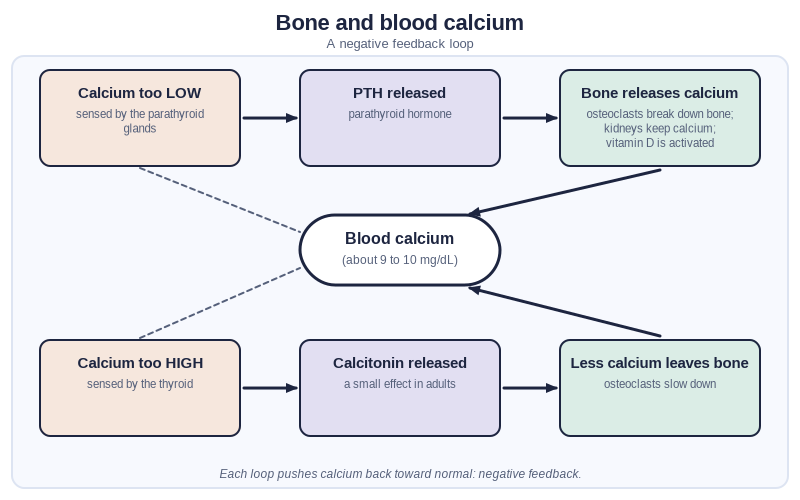
You saw this loop in Topic 2.3. When blood calcium falls, the parathyroid glands release PTH, which raises blood calcium (bone releases calcium, the kidneys keep it, and the gut absorbs more with the help of vitamin D). When blood calcium rises, the thyroid releases calcitonin, which helps lower it.
What the Loops Have in Common
Both loops have a sensor, a set point and an effector that reverses the change. Both use two opposing hormones to push the level up or down. Most of the hormone systems in this unit work this way, and many conditions arise when a loop stops working correctly.
Want more depth? Go to the Advanced lesson »
Worth a Pause
Think about how many loops are running in you at this moment: sugar, calcium, temperature, water, blood pressure, each one watched and corrected without a thought. Together they keep a bag of water and chemicals in a narrow range where life works. Nobody built a machine that does this so smoothly. Keep asking why: how does a body come to carry thermostats for a hundred different things?
Practice Problems
- Define homeostasis and name the parts of a negative feedback loop.
- Why is the labor example called positive feedback?
- What do beta cells release, and what does that hormone do to blood sugar?
- What do alpha cells release, and what does that hormone do?
- Where does the body store extra glucose, and what is it called when it is stored?
- Why are insulin and glucagon called antagonists?
- Which two hormones control blood calcium, and which one raises it?
- Draw or describe the loop that follows a big meal, from sensor to response.