Topic 5.4: Nervous and Endocrine Teamwork
The two messaging systems of the body are often described as separate, but they behave more like two halves of one team. A scary noise reaches your brain; seconds later your heart is pounding because a hormone has reached it; and all along, a small region of the brain called the hypothalamus is the contact point between the two systems.
This topic follows the chain of command: from the hypothalamus to the pituitary to a gland, with feedback to close the loop, and then shows how the nervous system and endocrine system share the work in a crisis.
The Hypothalamus: Where Brain Meets Hormones
The hypothalamus receives information from the rest of the brain (stress, hunger, temperature, the light and dark cycle) and from the blood (hormone and nutrient levels). It turns that information into hormone signals that control the pituitary, which in turn controls other glands (Topic 5.2).
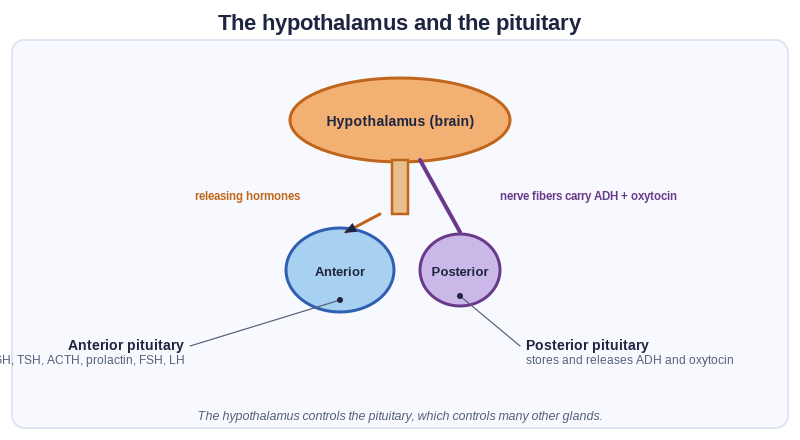
The usual chain is:
Hypothalamus (releasing hormone) → Pituitary (stimulating hormone) → Target gland (its own hormone) → body cells
Each step is a hormone released in tiny amounts that causes a larger release from the next step, which is how a small signal can have a large effect.
An Axis With Feedback: the Thyroid
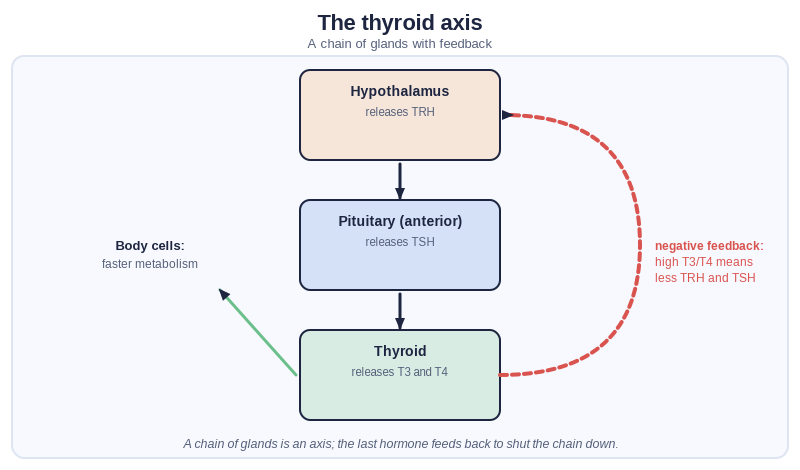
A chain of glands that controls one another is called an axis. The thyroid axis shows how the loop is closed with negative feedback.
- The hypothalamus releases TRH.
- The anterior pituitary releases TSH.
- The thyroid releases thyroid hormones (T3 and T4), which speed up the metabolism of cells.
- High levels of thyroid hormone in the blood tell the hypothalamus and pituitary to release less TRH and TSH.
The feedback keeps thyroid hormone in a steady range. If the thyroid hormone level falls, the brake lifts and TRH and TSH rise.
The Gonad Axis (Textbook Level)
The reproductive glands (gonads) are controlled by the same kind of axis. The hypothalamus releases a releasing hormone, the pituitary releases LH and FSH, and the gonads release their sex hormones, which feed back on the hypothalamus and pituitary. This axis controls the development of the body at puberty. The reproductive system itself is the subject of Unit 11.
Fight or Flight: Nerves First, Hormones Second
When you face a threat, both systems act.
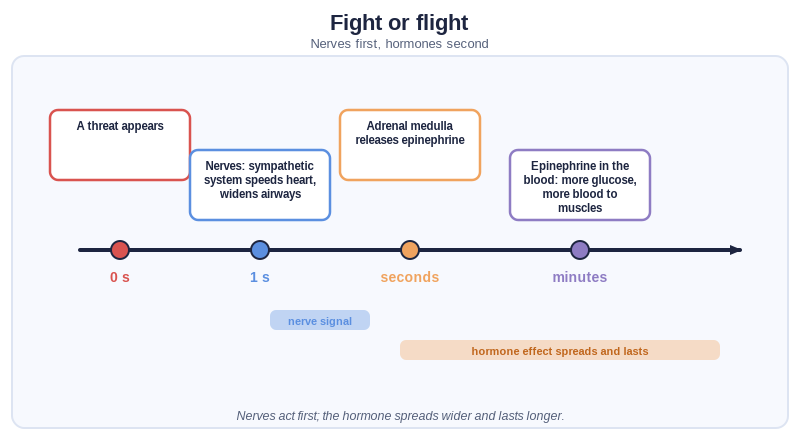
- Within a second: the sympathetic nervous system (Topic 4.5) speeds your heart and widens your airways.
- Within seconds: the sympathetic nerves also tell the adrenal medulla to release epinephrine into the blood.
- Over minutes: epinephrine reaches every cell and prolongs and strengthens the response: more glucose in the blood, more blood to muscles.
The nerve signal is quick; the hormone signal spreads wider and lasts longer. When the threat passes, the parasympathetic division and falling hormone levels settle the body down.
Worth a Pause
A sound, a signal, a gland the size of a pea, a hormone that finds its way to a heart a foot away, and a body that is ready to run before the thought of running is complete. The more closely one looks, the more the nervous system and the endocrine system look like parts of a single design. Keep asking why: why would a body be built with two systems that work so well together instead of one?
Practice Problems
- Why is the hypothalamus called the link between the nervous system and the endocrine system?
- Write the chain of command for an endocrine axis in order.
- Describe the thyroid axis, naming the hormone released at each step.
- How does negative feedback keep thyroid hormone levels steady?
- What does the gonad axis control at puberty? (A one-line answer is enough.)
- Compare the speed and spread of the nervous response with the hormone response in fight or flight.
- Which gland does the sympathetic nervous system signal during fight or flight, and which hormone does it release?
- Why can a small amount of hypothalamic hormone have a large effect on the body?