Topic 7.3: The Mechanics of Breathing
You do not push air into your lungs. You make room, and the air falls in.
That sounds backward, but it is how every breath you have ever taken works. A muscle changes the size of your chest, the size change changes the pressure, and the pressure moves the air. This topic shows how, step by step, and ends with a model you can build at home with a balloon and a bottle.
The Big Idea: Pressure Moves Air
Air always flows from a place of higher pressure to a place of lower pressure. Your body uses that rule. To breathe in, it makes the pressure inside the lungs lower than the pressure of the air outside. To breathe out, it makes the pressure inside higher. The way it changes the pressure is by changing the volume of the chest.
Boyle's Law: Volume and Pressure
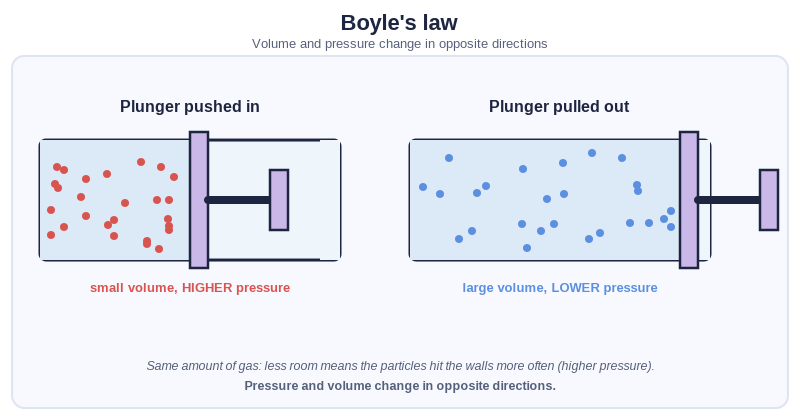
Boyle's law says that for a fixed amount of gas, pressure and volume change in opposite directions. If the volume of a container gets bigger, the pressure inside gets lower. If the volume gets smaller, the pressure gets higher. Pull back the plunger of a syringe and the air inside is spread over more space, so its pressure drops. (You may have met Boyle's law in chemistry. Here it is working inside your chest.)
Breathing In: Inhalation

- The diaphragm, a dome-shaped muscle under the lungs, contracts and flattens, moving down.
- The external intercostal muscles between the ribs contract and lift the ribs up and out.
- The chest gets bigger in every direction, and the lungs stretch with it.
- A bigger space means lower pressure in the lungs than in the air outside.
- Air flows in until the pressures are equal again.
Breathing Out: Exhalation
At rest, breathing out is mostly passive: it uses no muscle effort.
- The diaphragm and the rib muscles relax. The diaphragm rises back into its dome and the ribs drop.
- The lungs, which are elastic, spring back like a stretched balloon being let go.
- The chest space gets smaller, so the pressure in the lungs rises above the outside air.
- Air flows out.
When you need to breathe out harder (blowing out candles, exercising, coughing), the internal intercostal muscles and the abdominal muscles contract to squeeze the chest smaller. That is forced exhalation.
Why the Lungs Follow the Chest Wall
Each lung is wrapped in a thin, double-layered membrane called the pleura. One layer (the visceral pleura) clings to the lung and the other (the parietal pleura) lines the chest wall. Between them is a very thin film of fluid. Like a wet glass on a coaster, the two layers cannot be pulled apart easily, so when the chest wall expands, the lungs are pulled out with it. If air leaks into that space (a pneumothorax), the seal is lost and the lung can collapse.
The Balloon Model

A classic classroom model shows the idea. A clear bottle (or bell jar) stands for the chest. A balloon inside stands for a lung. A rubber sheet across the bottom stands for the diaphragm. When you pull the sheet down, the volume inside the bottle gets bigger, the pressure falls, and air rushes in through the tube to inflate the balloon. When you let the sheet go, the volume shrinks, the pressure rises, and the balloon deflates. The model is not perfect (real lungs have no empty space around them), but it shows the key idea: a change in volume makes a change in pressure, and air follows the pressure.
Counting Breaths
A healthy adult at rest breathes about 12 to 20 times a minute, which is something like twenty thousand breaths a day. Topic 7.5 shows how the brain keeps count.
Want more depth? Go to the Advanced lesson »
Worth a Pause
Twenty thousand times a day you take a breath you did not plan, and you have done it since the first minute of your life. You are held together by a quiet pattern of pressure and release, and you rarely notice it unless it stops. A free gift, delivered by the same physics that moves a syringe plunger. Keep asking why: why would a world and a body fit together so well that the air itself is happy to fall into you?
Practice Problems
- Why does air flow into the lungs during inhalation?
- State Boyle's law in your own words and give one example.
- Describe what the diaphragm and the external intercostal muscles do during inhalation.
- Why is quiet exhalation called passive?
- Name two muscle groups that help with forced exhalation.
- What is the pleura, and why is it important for breathing?
- In the balloon model, what do the bottle, the balloon and the rubber sheet stand for? What happens when the sheet is pulled down?
- A student says, "You push air into your lungs." Correct this, using the words volume and pressure.