Topic 6.6: Blood Pressure and Circulation Pathways
When you stand up quickly from a chair, your blood has to be pushed uphill against gravity, and your brain should never notice. A split second after you stand, sensors in your neck check your blood pressure, and a reflex adjusts your heart and vessels so you stay steady.
This last topic of the unit puts the vessels into pathways, explains what the two blood pressure numbers mean, and shows how the body keeps pressure in range.
Two Circuits
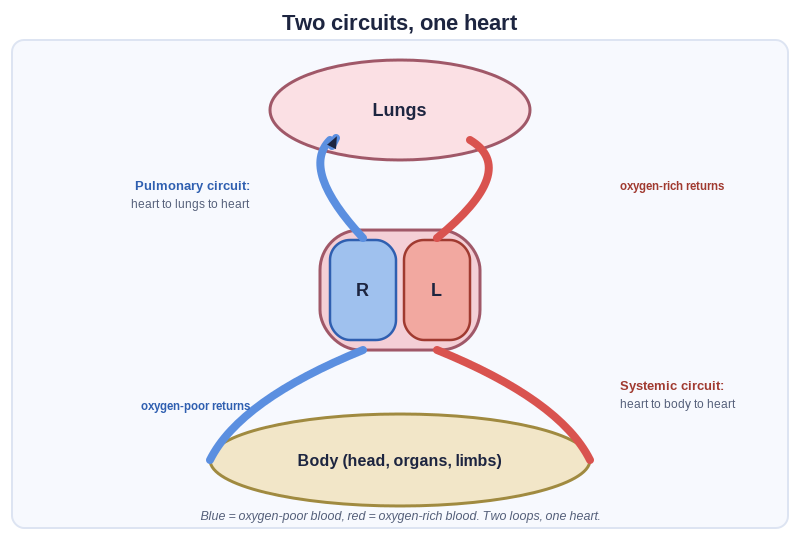
The cardiovascular system is a double loop.
- The pulmonary circuit carries blood from the right ventricle to the lungs and back to the left atrium. Its job is to pick up oxygen and drop off carbon dioxide.
- The systemic circuit carries blood from the left ventricle to the rest of the body and back to the right atrium. Its job is to deliver oxygen and nutrients and carry away waste.
Special pathways branch off the systemic circuit. The coronary circulation feeds the heart muscle, and the hepatic portal system carries blood from the digestive organs to the liver first (Unit 8).
The Main Vessels

The aorta leaves the left ventricle, arches over the heart and runs down the body, branching into the carotid arteries (head and neck), subclavian and brachial arteries (arms), arteries to the organs (including the renal arteries to the kidneys) and the iliac and femoral arteries (legs). Matching veins return the blood, and the superior vena cava and inferior vena cava empty into the right atrium.
Blood Pressure
Blood pressure is the force of blood against the walls of the vessels. It is measured in millimeters of mercury (mmHg) with two numbers, for example 120/80.
- Systolic (top number): the pressure when the ventricles contract.
- Diastolic (bottom number): the pressure when the ventricles relax.
A typical healthy adult reading is about 120/80 mmHg; readings that stay higher than that for long are called hypertension.
Blood pressure depends on three things: how hard and how fast the heart pumps (cardiac output), how narrow the vessels are (resistance) and the volume of blood. Raise any of them and pressure goes up.
Controlling Blood Pressure and Heart Rate

The nervous system adjusts pressure through negative feedback (Topic 5.3).
- Baroreceptors in the walls of the carotid arteries and the aortic arch sense stretch. If pressure rises, they signal the medulla, which increases parasympathetic activity and reduces sympathetic activity: the heart slows and vessels widen, so pressure falls. If pressure falls, the opposite happens.
- Chemoreceptors in the carotid and aortic bodies sense oxygen, carbon dioxide and acidity in the blood. When oxygen falls or carbon dioxide rises, they signal the brain to raise the heart rate and breathing.
The kidneys and hormones add longer-term control: the kidneys can change blood volume (Unit 9), and hormones such as epinephrine and ADH (Topic 5.2) adjust pressure.
Links to Other Systems
The cardiovascular system serves every other system: it delivers oxygen from the respiratory system, nutrients from the digestive system and hormones from the endocrine system; it carries wastes to the urinary system; it is steered by the nervous system; and its vessels share fluid with the lymphatic system (Unit 10).
Want more depth? Go to the Advanced lesson »
Worth a Pause
A pressure that is always right, for a heart that is always working, in a body that is always moving. You stand, sit, run and sleep, and your blood pressure quietly follows, thanks to sensors in your neck that you never thought of. Keep asking why: how did a body come to be wired with sensors that guard its pressure?
Practice Problems
- Compare the pulmonary circuit and the systemic circuit.
- Name three large arteries and the region each one supplies.
- What do the two numbers of a blood pressure reading mean? What is a typical healthy adult reading?
- Name three factors that affect blood pressure.
- Where are baroreceptors found, and what do they sense?
- Describe what happens when baroreceptors detect high blood pressure.
- What do chemoreceptors sense, and what response do they trigger when oxygen is low?
- Name two other body systems that the cardiovascular system serves, and say how.