Topic 3.5: Muscle Energy, Posture and Fitness
A sprinter can run flat out for ten seconds. A marathon runner can go for hours. Both use the same kind of muscle, and both run on the same fuel molecule, ATP. So why can one burn bright and quit while the other can keep going all day?
The answer is how fast each can make ATP. This topic follows the energy that powers muscle, and then looks at why muscles tire, why they are never completely relaxed, and how exercise changes them.
Muscle Runs on ATP
You learned in Topic 3.2 that every cross-bridge cycle uses ATP. But a muscle fiber stores only a tiny amount of ATP, enough for a few seconds of contraction. To keep working it must make new ATP, and it has three ways to do that.
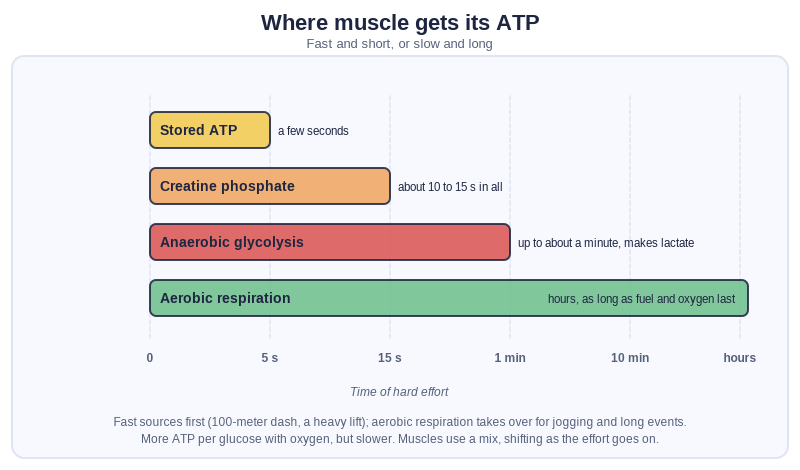
| Source | How it works | How long it lasts | Example |
|---|---|---|---|
| Stored ATP | Already in the fiber | A few seconds | The first instant of a jump |
| Creatine phosphate | A stored compound hands a phosphate to ADP to make ATP very quickly | About 10 to 15 seconds in all | A 100-meter dash, a heavy lift |
| Anaerobic glycolysis | Breaks down glucose without oxygen, quickly but with little ATP, and makes lactate | Up to about a minute | A 400-meter run |
| Aerobic respiration | Uses oxygen to fully break down glucose, then fats, in the mitochondria; makes much more ATP, but more slowly | Hours, as long as fuel and oxygen last | Jogging, walking, a marathon |
At rest and during light exercise, muscle mostly uses aerobic respiration (Biology: cellular respiration). When effort is sudden and strong, it shifts toward the fast sources first.
Muscle Fatigue
Fatigue is the loss of the muscle's ability to keep contracting with the same force. Causes include running low on ATP and fuel, changes in the chemistry inside the fiber (including the buildup of acid and lactate), and signals from the brain that tell you to slow down. A rest lets the muscle recover.
After hard exercise you keep breathing heavily for a while. Your body is using extra oxygen to restore ATP and creatine phosphate stores, to clear lactate, and to bring your muscles and body temperature back to normal. This extra oxygen use during recovery is sometimes called oxygen debt.
Muscle Tone and Posture
Even when you are not moving, your muscles are never completely off. A small number of fibers in each muscle are always contracting, taking turns, which gives muscle tone. Tone keeps muscles firm and ready, helps hold your bones and joints steady, and, in the muscles of the back, neck and legs, keeps you upright against gravity. That is posture. Posture muscles are made to work for hours without tiring. Slouching shifts the load onto ligaments and joints.
Use It or Lose It
- Hypertrophy is growth in the size of muscle fibers, caused by resistance exercise such as lifting weights. Fibers get thicker, not more numerous.
- Atrophy is shrinking of muscle from disuse, injury or lack of nerve signals. A leg in a cast gets noticeably thinner.
Fiber Types (a Preview)
Skeletal muscles are a mix of fiber types.
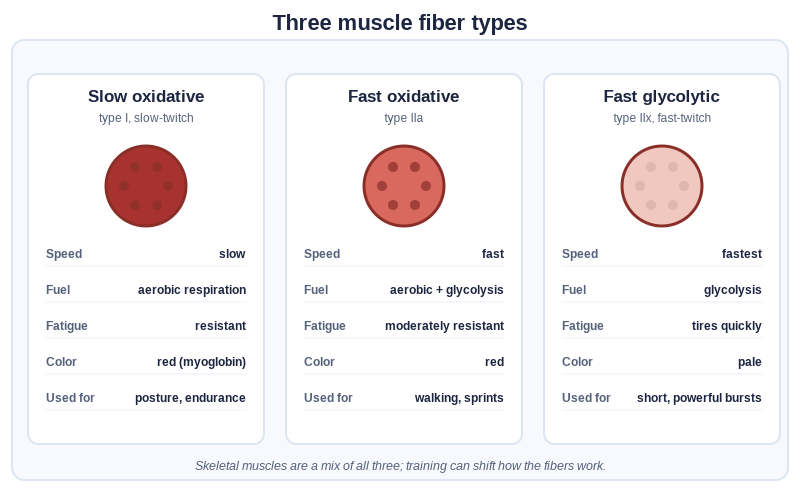
- Slow oxidative (slow-twitch) fibers contract slowly, resist fatigue and rely on aerobic respiration: posture and endurance.
- Fast glycolytic (fast-twitch) fibers contract quickly and powerfully but tire fast: sprints and lifts.
- Fast oxidative fibers are in between.
Training can change how your fibers work, but the mix you start with is largely inherited.
Exercise and Heat
Muscle is a heat engine: much of the energy it uses ends up as heat, which is why you warm up when you exercise and why you shiver when you are cold (Topic 1.6). A healthy plan includes aerobic exercise for the heart and endurance, resistance exercise for strength, stretching for flexibility, and rest for repair.
Want more depth? Go to the Advanced lesson »
Worth a Pause
You are never at rest, even when you are sitting still. A quiet crowd of muscle fibers takes turns, holding you upright, keeping your joints in place and warming your body, and they never ask for thanks. What you build or neglect today, a stronger frame or a weaker one, you will carry for decades. Keep asking why: why does a body that is built to repair itself also respond so strongly to how we use it?
Practice Problems
- Why can a muscle fiber not rely only on its stored ATP?
- Name the four sources of ATP for muscle in order from fastest to longest lasting.
- What is the difference between aerobic and anaerobic energy production?
- Which energy source fits a 100-meter dash, and which fits a long jog? Explain.
- Name two causes of muscle fatigue.
- What is muscle tone, and why does it matter for posture?
- Compare hypertrophy and atrophy.
- Which fiber type would a marathon runner have more of, and why?
Keep Exploring
Here are some resources that will help you keep digging deeper into this lesson's materials.
- Muscle Mechanics: Twitch, Summation and Tetanus (Ninja Nerd, 35:26) (video on YouTube)