Topic 1.2: Cell Structure Meets Function
A red blood cell and a nerve cell both come from the same human body, and both carry the same genes. Yet one is a tiny, flexible disc that squeezes through the narrowest blood vessels, and the other can stretch more than a meter from your spine to your toes. Same instructions, wildly different builds. Why?
Because what a cell is built like decides what it can do. This topic is a tour of the parts inside a cell, and by the end you will be able to look at a cell's shape and parts and make a smart guess about its job.
The Cell as a Tiny City
Picture a small city with walls, a city hall, power plants, factories, a post office and a recycling center. A cell has all of those, in miniature. The working parts inside the cell are called organelles, which means "little organs."
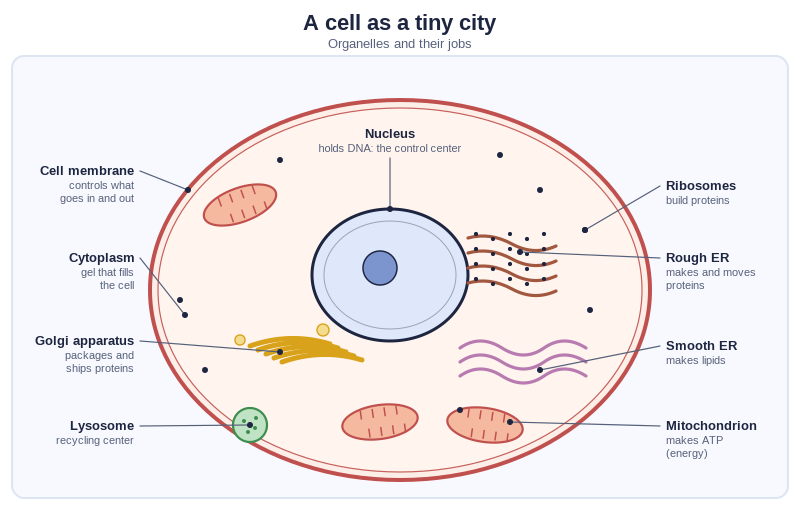
The Parts and Their Jobs
Plasma membrane (the city wall and gates). A thin, flexible boundary made of a double layer of fat-based molecules (phospholipids) with proteins embedded in it. It keeps the inside separate from the outside and is selectively permeable: it lets some things in and out and keeps others where they belong.
Cytoplasm (the city itself). Everything between the membrane and the nucleus: a watery gel called cytosol with the organelles floating in it. A web of tiny protein fibers, the cytoskeleton, gives the cell its shape and moves things around inside it.
Nucleus (city hall). Holds the cell's DNA, the instruction manual for building every protein in the body. It is wrapped in a double membrane with pores that let messages out. Most cells have one nucleus.
Ribosomes (the construction crews). Tiny machines that read instructions and build proteins. Some float freely; some are attached to the rough ER.
Endoplasmic reticulum, or ER (the factory floor). A maze of flattened sacs and tubes. Rough ER is dotted with ribosomes and makes proteins that will leave the cell or go in the membrane. Smooth ER has no ribosomes and makes fats (lipids), helps break down some harmful substances, and in muscle cells stores calcium.
Golgi apparatus (the post office). A stack of flattened sacs that receives proteins from the ER, finishes them, sorts them and ships them in little bubbles called vesicles to where they are needed.
Mitochondria (the power plants). Break down food molecules, with oxygen, to make ATP, the energy currency the cell spends on everything it does. They have an outer membrane and a folded inner membrane. Cells that use lots of energy, like muscle cells, are packed with them.
Lysosomes (the recycling center). Little sacs full of digestive enzymes that break down worn-out parts, food particles and invaders.
| Organelle | Job in one line | City comparison |
|---|---|---|
| Plasma membrane | Controls what goes in and out | City wall and gates |
| Nucleus | Stores DNA, directs the cell | City hall |
| Ribosomes | Build proteins | Construction crews |
| Rough ER | Makes and folds proteins | Factory floor |
| Smooth ER | Makes lipids, detoxifies | Specialty workshop |
| Golgi | Modifies, sorts, ships | Post office |
| Mitochondria | Make ATP energy | Power plant |
| Lysosomes | Digest and recycle | Recycling center |
Moving Things Across the Membrane
Cells constantly trade with their surroundings. Two ideas are enough for now. Diffusion is the natural spreading of molecules from where they are crowded to where they are scarce; it costs the cell no energy. Osmosis is diffusion of water across a membrane. When a cell has to move something against that natural flow, it uses ATP, which is called active transport.
Structure Fits Function
Now the payoff. Compare four cells.

- Red blood cell. A flexible, disc-shaped cell with a dip on each side. It has no nucleus when mature, which leaves more room for the protein that carries oxygen. The shape gives lots of surface for oxygen to move across and lets the cell bend through tiny vessels.
- Neuron (nerve cell). A cell body with long thin extensions that carry electrical signals over long distances. Shape is built for sending messages fast.
- Skeletal muscle cell. Long, with many nuclei and lots of mitochondria, because contracting takes a great deal of ATP.
- Skin (epidermal) cell. Flat and tightly packed, filled with a tough protein called keratin. Built to form a protective, waterproof barrier.
Four cells, one pattern: structure fits function. You will see it at every level of the body.
Want more depth? Go to the Advanced lesson »
Worth a Pause
Here is a thought experiment: you have roughly 30 to 40 trillion cells, and each one is running its own power plant, post office and recycling center right now, in a space too small to see. Nobody is supervising them. So how does a cell know which parts to build, and how many, and where to put them? Scientists are still answering questions like that. Keep asking why. The question is half the fun.
Practice Problems
- Match each organelle with its job: nucleus, ribosome, mitochondrion, lysosome, Golgi apparatus. Jobs: (a) digest and recycle, (b) make ATP, (c) sort and ship proteins, (d) store DNA, (e) build proteins.
- What does it mean that the plasma membrane is selectively permeable?
- What is the difference between rough ER and smooth ER?
- Why do muscle cells contain so many mitochondria?
- A mature red blood cell has no nucleus. How does that help it do its job?
- Neurons have long, thin extensions. How does that shape fit their function?
- Diffusion does not use energy but active transport does. Explain the difference in your own words.
- A cell has plenty of ribosomes on its rough ER and a large Golgi apparatus. What do you predict this cell does for a living?
Keep Exploring
Here are some resources that will help you keep digging deeper into this lesson's materials.
- Osmosis (The Noted Anatomist, 5:31) (video on YouTube)
- Membrane transport (The Noted Anatomist, 14:22) (video on YouTube)
- Cell Membrane Structure & Function (Ninja Nerd, 39:16) (video on YouTube)
- Cell Nucleus Structure & Function (Ninja Nerd, 31:17) (video on YouTube)
- Mitochondria Structure & Function (Ninja Nerd, 34:19) (video on YouTube)
- Endoplasmic Reticulum Structure & Function (Ninja Nerd, 30:03) (video on YouTube)
- Golgi Apparatus Structure & Function (Ninja Nerd, 25:14) (video on YouTube)
- Lysosomes Structure & Function (Ninja Nerd, 28:36) (video on YouTube)
- Cell Biology | Cell Structure & Function (Ninja Nerd, 55:35) (video on YouTube)